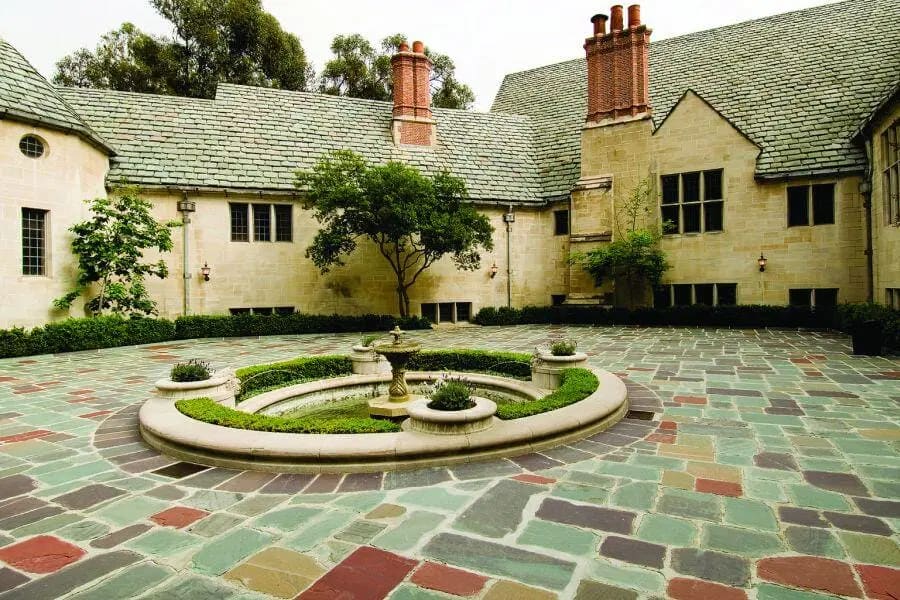

Greystone Mansion is one of those places that makes Beverly Hills seem almost understated. It is not simply a large house. It is a 46,000 square foot stone estate with 55 major rooms, formal gardens, a private entertainment wing and the kind of infrastructure normally associated with a small institution rather than a family residence. Yet the most famous chapter in its history is not about architecture or luxury. It is about the violent deaths of two men inside the house only months after the owners moved in.
My take is that Greystone may be the most complete Los Angeles landmark we have. It contains nearly every element of the city’s mythology: oil money, unchecked ambition, political scandal, extraordinary Los Angeles real estate, Hollywood reinvention and a mystery that wealth may have helped bury.
A Wedding Gift Measured in Acres
Greystone was created by Edward L. Doheny, one of the dominant figures in the early Southern California oil industry, for his only surviving son, Edward “Ned” Doheny Jr. In 1926, the elder Doheny gave Ned and his wife, Lucy, a 12.58 acre parcel overlooking the Los Angeles Basin as a wedding gift. Construction began in February 1927, and the family moved into the house in September 1928, even as work on the wider estate continued.
The cost was staggering. The full estate reportedly cost $3,166,578.12, with the mansion itself accounting for more than $1.2 million. Those numbers sound almost quaint beside modern Beverly Hills prices, but in the late 1920s they represented an almost unimaginable private investment. Greystone was not merely intended to be comfortable. It was designed to make the Doheny family’s position visible.
Architect Gordon B. Kaufmann designed the mansion, while landscape architect Paul Thiene planned the grounds. The result is generally described as English Revival, Tudor or Jacobean in style, although “Early Los Angeles Baronial” may be the most accurate description. The exterior is faced with gray Indiana limestone, the roof is covered in thick Welsh slate, and the house is built around a reinforced concrete and steel frame. The craftsmanship inside included Italian marble, hand carved balustrades, oak and walnut paneling, leaded windows and elaborate chandeliers.
What I find most impressive is that the house still feels serious. Many great estates from this period are theatrical, but Greystone does not need to perform for you. The heavy stone, deep rooms and formal layout create an atmosphere that feels almost governmental. It was a family home, but it was built with the confidence of a dynasty.
A Private World Above Beverly Hills
Greystone had nearly everything a wealthy family in the 1920s could have imagined. Its recreation wing included a theater, billiard room and two lane bowling alley. The property also had tennis courts, a swimming pool and pavilion, stables, kennels, garages, workshops, a greenhouse, a gatehouse and its own fire station. The landscaped grounds incorporated a lake, streams, fountains and cascading waterfalls.
That list can sound like trivia until you understand what it says about the estate. Greystone was not just a mansion with amenities. It was a self contained world. The family could entertain, exercise, watch films, stable horses, maintain vehicles and respond to a fire without relying entirely on the city below.
Modern luxury homes often compete through finishes, technology and views. Greystone competed through scale and autonomy. The real status symbol was not a marble bathroom. It was having enough land, staff and infrastructure to make ordinary life happen without leaving the property.
There is also a strange bit of Hollywood symmetry here. Upton Sinclair’s novel Oil! was inspired in part by Edward Doheny’s rise and the scandals surrounding his empire. Paul Thomas Anderson later used the novel as the starting point for There Will Be Blood. The film’s final bowling alley sequence was shot inside Greystone, the home built by Doheny for his son. A fictional oil baron inspired by the Doheny world ends his story in the Doheny family bowling alley. Los Angeles history rarely wraps itself up that neatly.
Four Months Later, Two Men Were Dead
On the night of February 16, 1929, Ned Doheny and his close friend and assistant, Hugh Plunkett, were found shot inside a ground floor guest suite at Greystone. This is worth clarifying because the room is sometimes described as a parlor or one of the mansion’s grand public spaces. Contemporary accounts place the bodies in the South Guest Room, a suite that also functioned as a study and a place where Plunkett sometimes stayed.
The official conclusion came quickly. Authorities said Plunkett had shot Ned and then killed himself. Plunkett had reportedly been struggling with his mental health, and the Doheny household’s account supported the murder-suicide theory.
But one of the investigators at the scene, Leslie T. White of the Los Angeles County District Attorney’s office, believed the physical evidence did not fit that story. White later wrote that powder burns around Ned’s wound suggested the gun had been fired from only inches away, while Plunkett’s wound lacked the same evidence. The revolver found beneath Plunkett was reportedly still warm several hours after the shots, and investigators found no usable fingerprints on it. The timing was also troubling. The shots were said to have occurred before 11 p.m., but law enforcement did not arrive until after 2 a.m.
The case was closed roughly 36 hours after the deaths. No additional autopsy on Ned was publicly disclosed, and the official finding remained that Plunkett had committed murder and suicide.
None of those inconsistencies proves a different theory. They do not establish that Ned shot Plunkett, that another person entered the room or that the family staged the scene. They do, however, explain why the story has never felt settled. When evidence conflicts with testimony and an investigation involving one of the most powerful families in Los Angeles ends almost immediately, questions are inevitable.
To me, the most interesting part of the Greystone mystery is not choosing the most dramatic theory. It is recognizing how quickly an official story can become permanent when the people surrounding it have wealth, influence and a strong interest in avoiding scandal. Real estate can preserve architecture, but it can also preserve a version of history.
From Private Estate to Trousdale Estates
Lucy Doheny continued living at Greystone after Ned’s death. She later remarried and remained there until the 1950s. By then, the scale that had once represented unlimited possibility had become difficult to maintain.
Lucy sold the surrounding Doheny ranch land to developer Paul Trousdale, who transformed it into Trousdale Estates. The remaining 18.3 acre parcel containing Greystone Mansion was sold separately to industrialist Henry Crown. Crown did not make the estate his home and instead leased it for filming. The City of Beverly Hills purchased the property in 1965, dedicated it as a public park in 1971 and preserved it as a historic landmark. Greystone was added to the National Register of Historic Places in 1976.
This is where Greystone’s story becomes especially relevant to Los Angeles real estate. The mansion began as a private monument surrounded by hundreds of acres. Much of that land was eventually subdivided into one of Beverly Hills’ defining residential neighborhoods. The original estate did not disappear. It became the organizing history behind an entirely new luxury market.
You can still feel that connection in Trousdale Estates. The neighborhood’s identity comes from elevation, views, privacy and limited land, the same qualities that attracted the Dohenys in the first place. The architecture changed from English stone manor houses to low slung modern residences, but the basic promise remained the same: separation from the city without losing sight of it. Understanding these overarching, infrastructure-driven estate blueprints across the Platinum Triangle is a main focus of our Los Angeles Area Guide.
That is one reason history matters when evaluating Los Angeles property. A neighborhood is not just a collection of comparable sales. Its value is shaped by the decisions that created it, the land that was preserved, the land that was divided and the story buyers believe they are joining.
br />Greystone Today
Greystone is now a public park, and the grounds can be visited without buying a ticket. Access to the mansion itself is more limited and generally takes place through scheduled programs, tours and events. The estate also remains an active filming and photography location.
When you visit, I would not rush directly to the murder story. Start with the site plan. Notice how the house sits on the hill, how the wings create distinct public and service areas, and how the terraces frame the view. Walk through the gardens and pay attention to how movement through the property was choreographed. Greystone is not only a historic house. It is a master class in estate planning. Evaluating the macro-realities of raw acreage follows a similar line of custom property diligence to what we detail when breaking down how to buy land in Malibu.
Then, of course, look toward the guest suite where Ned Doheny and Hugh Plunkett died. Nearly a century later, the official explanation remains intact, but certainty does not.
That tension is what makes Greystone unforgettable. It is beautiful without being warm, extravagant without being frivolous and public even though it was designed to keep the public out. It tells the story of a family, but it also tells the story of Los Angeles: a city where fortunes reshape the land, private tragedies become entertainment and the most valuable properties are often the ones with the most complicated pasts. For regular market trajectory reviews across nearby custom tracts, you can easily track data updates on our primary Los Angeles Real Estate Blog hub.
If you are considering buying or selling a home in Trousdale Estates, Beverly Hills or anywhere else in Los Angeles, feel free to read more about my practice or contact me, Tyler Neale directly. I can help you understand not only the market, but the history and character that make each neighborhood different. Contact me for expert Los Angeles real estate guidance.