
It takes an extraordinary house to offend the residents of Holmby Hills.
This is a neighborhood where estates occupy multiple acres, privacy is treated as an essential service and some of the wealthiest people in the world live behind gates almost anonymously. Large homes are not exactly unusual here.
But when television producer Aaron Spelling began constructing what became known as Spelling Manor, even his extraordinarily wealthy neighbors thought he had gone too far.
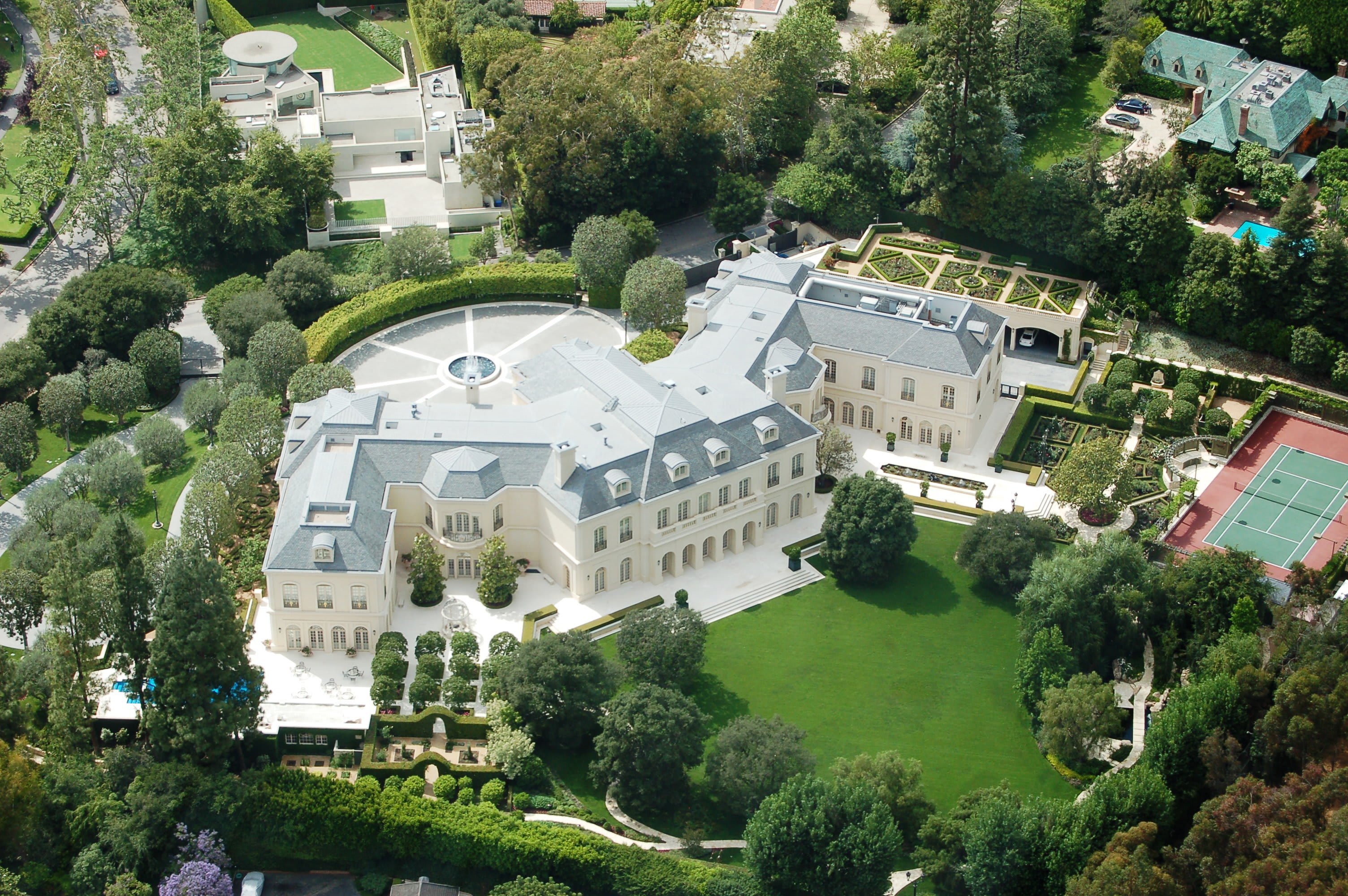
The house eventually grew to approximately 56,500 square feet. It rose more than 50 feet, contained over 100 rooms and became slightly larger than the White House. During construction, it attracted sightseers, generated years of noise and truck traffic and blocked at least one neighbor’s view of the sunrise. One couple across the street secured a permanent injunction imposing restrictions on the construction operation.
Today, Spelling Manor is considered one of the defining trophy estates in Los Angeles. But before it became an icon, it was the house that made Holmby Hills furious.
That transformation is what interests me. Los Angeles often resists its most audacious buildings while they are being created, then embraces them as landmarks once enough time has passed. Tracking these highly unique luxury properties across the Platinum Triangle requires the same attention to local context that we detail in our master Los Angeles Real Estate Blog hub.
Before the Manor, There Was Another Significant Estate
Spelling Manor was not built on vacant land.
Aaron and Candy Spelling acquired the property in 1983 for approximately $10.25 million. At the time, the site contained a residence once occupied by Bing Crosby. That earlier house had been built in 1932 and designed by Gordon Kaufmann, the architect responsible for some of Southern California’s most important buildings, including Greystone Mansion.
The previous owner had reportedly considered subdividing the property. The Spellings instead demolished the existing residence and consolidated their vision around one enormous new estate.
There is an interesting preservation question hidden inside that decision. Today, a Kaufmann-designed home with a Bing Crosby connection would almost certainly be promoted as an architectural treasure. In the 1980s, it was treated as an obstacle standing in the way of something bigger.
That is very Los Angeles.
We are a city that celebrates history, but we have also repeatedly erased it in favor of the next idea. Spelling Manor became famous enough to justify the loss in the public imagination, but that outcome was not guaranteed when demolition began.
Building a House Bigger Than a Football Field
The Spellings hired James Langenheim & Associates to design a French château-style residence. Contemporary reporting described the project as approximately 56,500 square feet on roughly six acres, with a permit valuation of $12 million. Its limestone exterior required imported stone, while dirt was brought onto the property to reshape the site.
The proposed structure was technically two stories, but that description understates its scale. It also included a basement and an intermediate level between the second floor and attic for closets.
Those closets became part of the building’s legend before the family had even moved in.
In 1986, the city’s Board of Building and Safety Commissioners approved a request allowing two large closet areas and adjoining balconies on the intermediate level without counting the space as a full additional story. The decision also waived a second-exit requirement that would normally have applied to a third floor.
The finished estate would include a screening room, gym, bowling alley, swimming pool, tennis court and multiple garages. Rumors about even more extravagant features circulated throughout construction, forcing Aaron Spelling to publicly dispute reports that the property would have three kitchens, 12 fountains and a 6,000-square-foot guesthouse.
Some of those rumors were inaccurate, but they reveal how quickly the project had captured the public imagination. People were ready to believe almost anything about it because the verified facts were already so extreme.
Why the Neighbors Fought Back
The dispute was not simply about architectural taste.
Construction on this scale changes the experience of an entire street. Trucks arrive constantly. Workers fill the area. Dirt, noise and debris become part of everyday life. Sightseers begin driving by, particularly when the person building the house is one of Hollywood’s most successful producers.
Audrey and Sydney Irmas lived across the street. They filed for an injunction against Spelling and the construction company in December 1985. Audrey Irmas complained about trucks damaging lawns, discarded beer cans, unmanaged weeds and years of disruption. She also said the mansion blocked her view of the sunrise.
The permanent injunction limited the number of trucks permitted at the site, required weeds to be cleared and provided for repairs when neighboring property was damaged. By 1988, construction had been unfolding in different stages for approximately four years.
Another neighbor, former PSA chairman J.P. Guerin, said that the normally peaceful neighborhood had been overwhelmed by noise, strangers and sightseers. He acknowledged that the Spellings’ representatives responded when damage needed to be corrected, but he also made it clear that Aaron Spelling’s Hollywood status did not impress the people living around him.
That may be my favorite part of this story. In almost any other neighborhood, Aaron Spelling would have been the most powerful and famous person on the block. In Holmby Hills, he was simply the neighbor creating too much construction traffic.
Were the Neighbors Right?
Honestly, I understand their frustration.
It is easy to look at the completed mansion nearly four decades later and dismiss the opposition as wealthy people complaining about another wealthy person. But years of construction can make daily life miserable regardless of the value of the surrounding homes.
Privacy is also one of the primary reasons people pay Holmby Hills prices. A project that turns a quiet street into a sightseeing destination undermines one of the neighborhood’s greatest selling points. Managing structural scale within an already established neighborhood context is an ongoing theme throughout the region—similar to the block-specific real estate considerations outlined in our overview of living in Venice Beach.
At the same time, the Spellings had purchased a major estate property and were legally entitled to develop it within the approvals they received. The house may have been excessive, but excess is practically part of the architectural language of the Platinum Triangle.
My view is that the neighbors were justified in demanding responsible construction management. Limiting trucks, repairing damage and controlling debris were reasonable expectations. But objecting to the home simply because it visibly displayed wealth is more complicated. Holmby Hills was never designed around modesty.
The real issue was not merely that the house was large. It was that its size escaped the visual hierarchy of the neighborhood. It dwarfed homes that were already mansions.
A House Designed for Hollywood
Spelling Manor makes more sense when you understand Aaron Spelling’s career.
He produced some of the most successful television programs of his era, including Charlie’s Angels, Dynasty, The Love Boat, Fantasy Island and later Beverly Hills, 90210. His shows were glamorous, highly polished and unapologetically entertaining.
The house operated according to the same philosophy.
Its grand staircase reportedly took inspiration from Gone with the Wind. Its screening room connected the residence to the entertainment empire that paid for it. Specialized spaces allowed the family to host events, store vast collections and operate the property almost like a private hotel.
The result was not restrained architecture, but restraint was never the point.
Some critics saw the mansion as a monument to bad taste and conspicuous consumption. One neighbor described it at the time as “Look-at-me-I’m-rich architecture.”
That criticism is not entirely unfair. The house was designed to communicate wealth at a scale that could not be ignored.
But architecture does not have to be subtle to become important. Spelling Manor represents a specific moment in Los Angeles when network television could create enormous personal fortunes and Hollywood success was expressed through land, architecture and spectacle.
It is not just a big French-inspired house. It is a physical monument to the peak of the television producer as Hollywood kingmaker.
How Controversy Became Prestige
The complaints eventually quieted. Construction ended, landscaping matured and the mansion became part of the neighborhood.
That pattern happens throughout Los Angeles. A project is initially treated as an intrusion. Years later, it becomes one of the very properties that defines the area.
Spelling Manor’s later sales helped cement that status. Candy Spelling sold the estate to Formula One heiress Petra Ecclestone in 2011 for $85 million. After an extensive interior transformation, it sold again in 2019 for just under $120 million, setting a major California price record at the time.
In 2025, former Google chief executive Eric Schmidt and his wife, Wendy Schmidt, purchased the Manor for $110 million. The property had most recently been asking $137.5 million. The Schmidts reportedly plan to keep it as a private residence while also using it for meetings and events benefiting Los Angeles nonprofit and cultural organizations. They have also considered simplifying the layout and improving the estate’s energy efficiency.
The house that neighbors once wished would disappear is now treated as an irreplaceable piece of Los Angeles real estate.
What Spelling Manor Teaches Luxury Buyers and Sellers
The story offers several lessons that apply well beyond a 56,500-square-foot mansion.
The first is that being permitted to build something does not mean the surrounding community will welcome it. Large renovations and new construction require more than architectural plans. They require careful management of traffic, noise, security, debris and neighbor relationships.
The second is that privacy and visibility often conflict. A famous or architecturally dramatic home can generate attention, but that attention may affect the day-to-day experience of living there. While centralized urban updates bring their own infrastructure considerations—as highlighted across our look at development shifts in Downtown Los Angeles—high-end estate development remains an entirely unique logistical equation.
The third is that scale alone does not determine value. Spelling Manor sold in 2025 for less than its reported 2019 price, despite remaining one of the most recognizable homes in the country. At this level, the buyer pool is exceptionally small. A property can be unique and still require patience, strategic pricing and the right buyer.
Most importantly, a home’s history can become a significant part of its value.
The controversy surrounding Spelling Manor did not permanently diminish it. The construction battle, the celebrity connection, the extreme dimensions and the ownership history all became chapters in the property’s mythology.
That does not happen with every large house. Many mega-mansions are simply big. Spelling Manor has a story.
Could Another Spelling Manor Be Built Today?
Technically, Los Angeles still produces enormous private residences. But recreating Spelling Manor would be extraordinarily difficult.
The land alone would be nearly impossible to assemble in the heart of Holmby Hills. Construction costs would be astronomical. Planning, environmental review, neighborhood objections and modern building requirements would all add complexity. Navigating strict regulatory layers on prime geography requires sorting through deep calculations, much like the factors we analyze when examining the challenges of buying land in Malibu.
A modern owner might also question whether 56,500 square feet is truly desirable. Even at the highest level of wealth, priorities have shifted toward wellness, sustainability, security and spaces that feel usable rather than simply enormous.
That may be why the Manor remains so fascinating. It comes from an era when the ultimate luxury was having a separate room for almost anything you could imagine, whether or not you would ever use it.
Was it excessive? Absolutely.
Was it disruptive? The neighbors made that very clear.
But Los Angeles would be less interesting without people occasionally attempting something unreasonable.
Spelling Manor did not blend into Holmby Hills. It challenged the neighborhood, overwhelmed it and ultimately became one of its most recognizable properties. The same scale that made it controversial is now the reason it can never be replaced.
If you are considering buying or selling a luxury home in Holmby Hills, Bel Air, Beverly Hills or anywhere else in Los Angeles, feel free to learn more about my practice or contact me, Tyler Neale directly. I can help you understand not only the property itself, but the history, neighborhood dynamics and market positioning that determine how an exceptional Los Angeles home should be valued and presented.