
Santa Monica is one of the most famous beach cities in the world. People think of the Pier, Palisades Park, ocean-view condos, beach cottages, luxury homes north of Montana, and walkable streets that feel more like a true coastal city than just another part of Los Angeles.
But Santa Monica was not always guaranteed to become a beach town.
At one point, it had a very real chance of becoming the commercial harbor for Los Angeles. The coastline we now associate with beach paths, hotels, restaurants, oceanfront living, and one of the most recognizable piers in America could have become something completely different. It could have been defined by ships, freight, rail lines, warehouses, and industrial infrastructure.
That is what makes this history so interesting. Santa Monica’s biggest loss may have become its biggest win.
Santa Monica Was Founded With Bigger Ambitions
Santa Monica was developed in 1875 by Nevada Senator John P. Jones and Colonel Robert S. Baker. Jones envisioned an oceanside resort town, but the location also had enormous commercial potential. Los Angeles was growing, and a growing city needed access to the Pacific.
This was not just about creating a charming beach destination.
In the 19th century, the future of a city was often tied to railroads and ports. Whoever controlled the rail connection and the harbor controlled access to trade, shipping, and regional power.
That is why Santa Monica was once much more than a scenic coastal outpost. It was a serious candidate for maritime commerce.
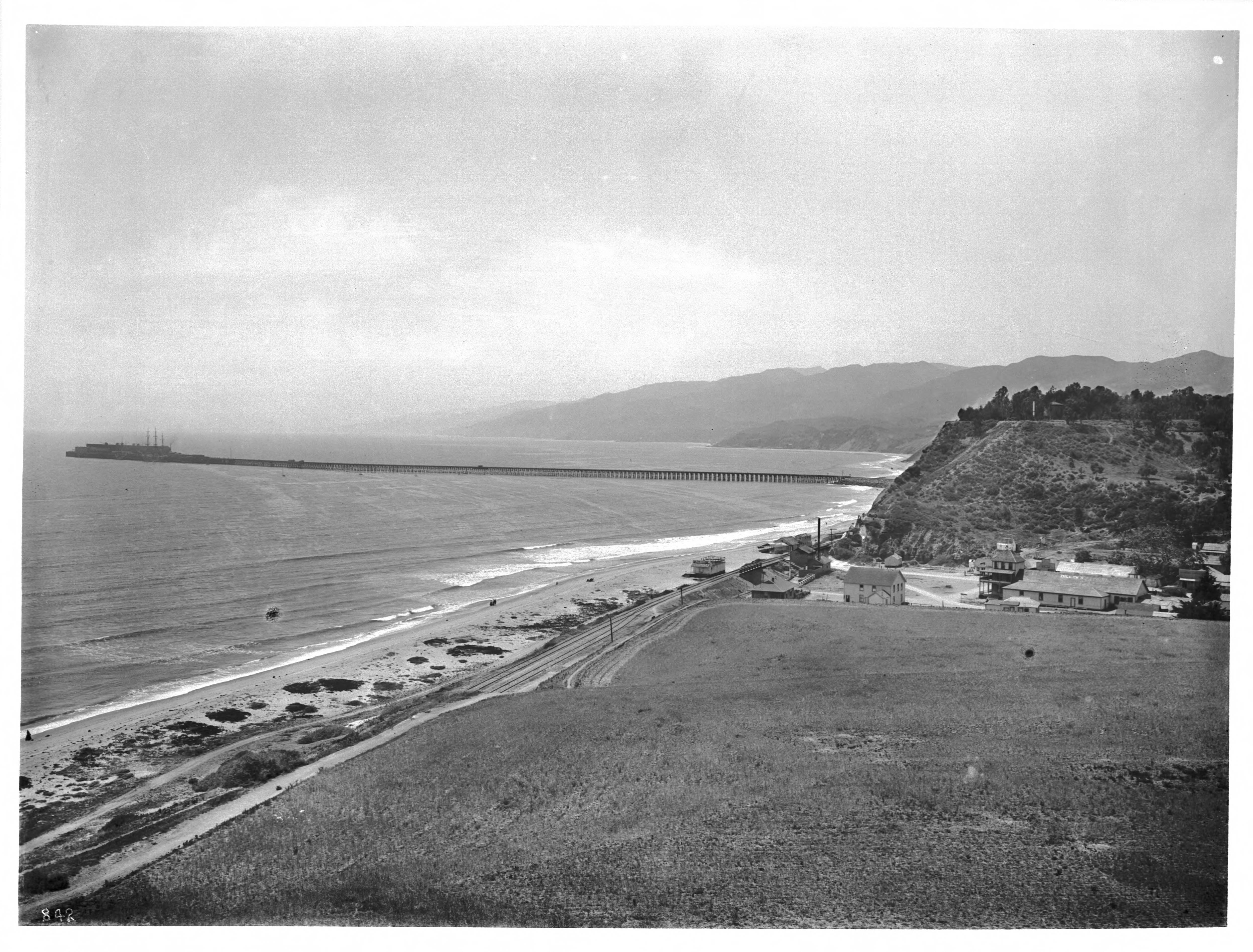
The photo used in this article shows that alternate future. This is not the Santa Monica most people picture today. It is Santa Monica as Port Los Angeles, with the Long Wharf extending far into the bay and railroad infrastructure connecting the coast to the region’s inland economy.
The Coastline Almost Became Industrial
When you stand on the Santa Monica Pier today, it is hard to imagine this stretch of coastline as a working harbor. The beach, the amusement rides, the ocean breeze, and the views all make Santa Monica feel like it was always meant to be recreational.
But history could have gone another way.
In the late 1800s, railroad interests pushed for Santa Monica to become the principal harbor for Los Angeles. Collis P. Huntington and the Southern Pacific Railroad backed Port Los Angeles at Santa Monica, while other civic and business leaders pushed for San Pedro. The fight became known as the Free Harbor Fight, and it was ultimately about whether the region’s future port would be controlled by railroad interests or developed at San Pedro Bay.
The Long Wharf, also known as Port Los Angeles, was constructed by the Southern Pacific Railroad in the 1890s. It extended deep into Santa Monica Bay so ships could load and unload cargo. For a time, Santa Monica was not just a beach. It was a serious shipping contender.
Santa Monica lost that fight.
But in hindsight, that loss may be the reason Santa Monica became Santa Monica.
The Harbor Left, the Beach Town Emerged
After San Pedro won the harbor battle, Santa Monica’s future as a major commercial port faded. Port Los Angeles closed to shipping in 1913, unable to compete with the improved harbor at San Pedro Bay. The Long Wharf was later torn down, leaving little physical evidence of the attempt to turn Santa Monica into LA’s commercial harbor.
That could have been the end of Santa Monica’s importance. Instead, the city’s identity changed.
Without an industrial port dominating the coastline, Santa Monica became more fully a leisure destination, beach resort, and eventually a residential community with some of the most desirable coastal real estate in Southern California. Much like evaluating properties across our comprehensive Los Angeles Area Guide, tracking local property values here requires looking past standard layouts and understanding true geographic history.
That transformation is the real estate lesson here.
Land value is not only about location. It is about what a location becomes. A coastline used for freight and cargo has one kind of value. A coastline preserved for recreation, housing, tourism, and daily quality of life has another.
If Santa Monica had become the Port of Los Angeles, it might still have been economically powerful. But it probably would not have become the place people dream of living.
The Pier Became the Symbol
The Santa Monica Pier did not begin exactly as the amusement destination people know today. The municipal pier opened in 1909, originally serving a utility function, and in 1916 Charles Looff built the Pleasure Pier beside it, bringing amusements and entertainment to the waterfront.
Over time, the Pier became the opposite of an industrial harbor.
It became playful. It became cinematic. It became one of the clearest visual symbols of Southern California coastal life.
That matters for real estate.
When people buy in Santa Monica, they are not only buying square footage. They are buying proximity to a lifestyle that has been built over generations. The beach, the bluffs, the Pier, the walkability, the ocean air, and the ability to live in a city while still feeling connected to the water are all part of the value.
This is why Santa Monica remains so desirable even when the city is facing real challenges.
Santa Monica Is Still Fighting for Its Next Chapter
Of course, Santa Monica’s history does not erase the challenges the city is facing today.
Downtown Santa Monica and the Third Street Promenade have dealt with vacancy issues, public safety concerns, homelessness, retail closures, and fiscal pressure. In 2026, the city announced an economic revitalization strategy with new tools to attract restaurants, expand entertainment zones, and encourage private investment.
That context matters because Santa Monica is not perfect. It is a world-famous beach city, but it is also a real city working through real urban problems. While other regional expansions focus heavily on newly concentrated commercial arenas—similar to the massive entertainment shifts outlined in our guide to living in Inglewood—Santa Monica is adapting within an already established urban core.
My take is this: Santa Monica’s challenges are serious, but they are not the same as a city losing its reason to exist.
Santa Monica’s core asset is still extraordinary. It is one of the few places in Los Angeles where you can have beach access, walkability, restaurants, shopping, parks, views, transit, global name recognition, and a real city lifestyle in one place.
The city has governance, retail, and quality-of-life issues to solve. But the underlying land value and lifestyle value remain incredibly strong.
That is very different from a place that has lost its fundamental appeal.
What Santa Monica Buyers Are Really Waiting For
For many buyers, the issue in Santa Monica is not desire. It is affordability.
People still want the beach, the walkability, the schools, the parks, the restaurants, and the lifestyle. The challenge is that higher interest rates have made the monthly payment feel dramatically different than it did a few years ago. Freddie Mac reported the average 30-year fixed mortgage rate at 6.49 percent as of July 9, 2026, which is still high enough to keep many buyers cautious.
That is why some buyers are sitting on the sidelines waiting for rates to come down.
The risk is that when rates do eventually improve, demand for places like Santa Monica may increase quickly because the underlying appeal never went away. A buyer who waits only for a better rate may find themselves competing with everyone else who had the exact same idea.
My advice is not that everyone should rush to buy. It is that buyers should study the neighborhood before the market gets more competitive. For deep strategy updates on listing approaches and long-term coastal scarcity during variable rate seasons, feel free to monitor updates on our live Los Angeles Real Estate Blog hub.
A condo near the beach, a house north of Montana, a property in Sunset Park, a walkable Ocean Park bungalow, and a luxury view property above the bluffs are all part of Santa Monica, but they do not perform the same way. They attract different buyers, have different risk profiles, and respond differently to market conditions.
For sellers, the lesson is different. In a higher-rate market, pricing and presentation matter more. Buyers are more selective, and they need a clear reason to choose one property over another.
In Santa Monica, that reason is often lifestyle. Proximity to the beach, walkability, outdoor space, architectural character, parking, privacy, and long-term coastal scarcity all matter. The job of a good listing strategy is to make those advantages obvious.
The Real Estate Takeaway
The reason this history matters is that Santa Monica’s value was shaped by what did not happen.
The city did not become LA’s industrial port. Its coastline was not consumed by freight yards. Its bluffs were not defined by rail and shipping infrastructure. Its most famous public landmark became a pleasure pier rather than a commercial wharf.
Because of that, Santa Monica became one of the most valuable coastal residential markets in California.
When I look at Santa Monica real estate, I do not just see a beach city with high prices. I see a place where a 19th century infrastructure decision completely changed the long-term trajectory of the land.
That is what makes Los Angeles real estate so fascinating. Neighborhoods are shaped by railroads, freeways, ports, zoning, politics, entertainment, migration, and luck. Sometimes the thing a city loses is exactly what allows it to become more valuable later.
Santa Monica lost the harbor.
But it kept the beach.
In the long run, that may have been the better deal.
If you are considering buying or selling a home in Santa Monica, or anywhere else in Los Angeles, feel free to read more about my practice or contact me, Tyler Neale directly. I can help you understand not just the market, but the history, lifestyle, and long-term value behind each neighborhood.