
Angelino Heights is one of those neighborhoods that makes Los Angeles feel older than people expect.
Most of LA’s early residential history has been erased, redeveloped, widened, demolished or paved over. But just above Echo Park and minutes from Downtown, Angelino Heights still gives you a glimpse of the city before freeways, before modern apartment towers and before the Westside became the center of prestige.
This was one of Los Angeles’ first suburbs, and City Planning still describes it as a hilltop residential area two miles northwest of Downtown with some of the city’s best surviving Victorian-era architecture. It later became Los Angeles’ first Historic Preservation Overlay Zone, or HPOZ.
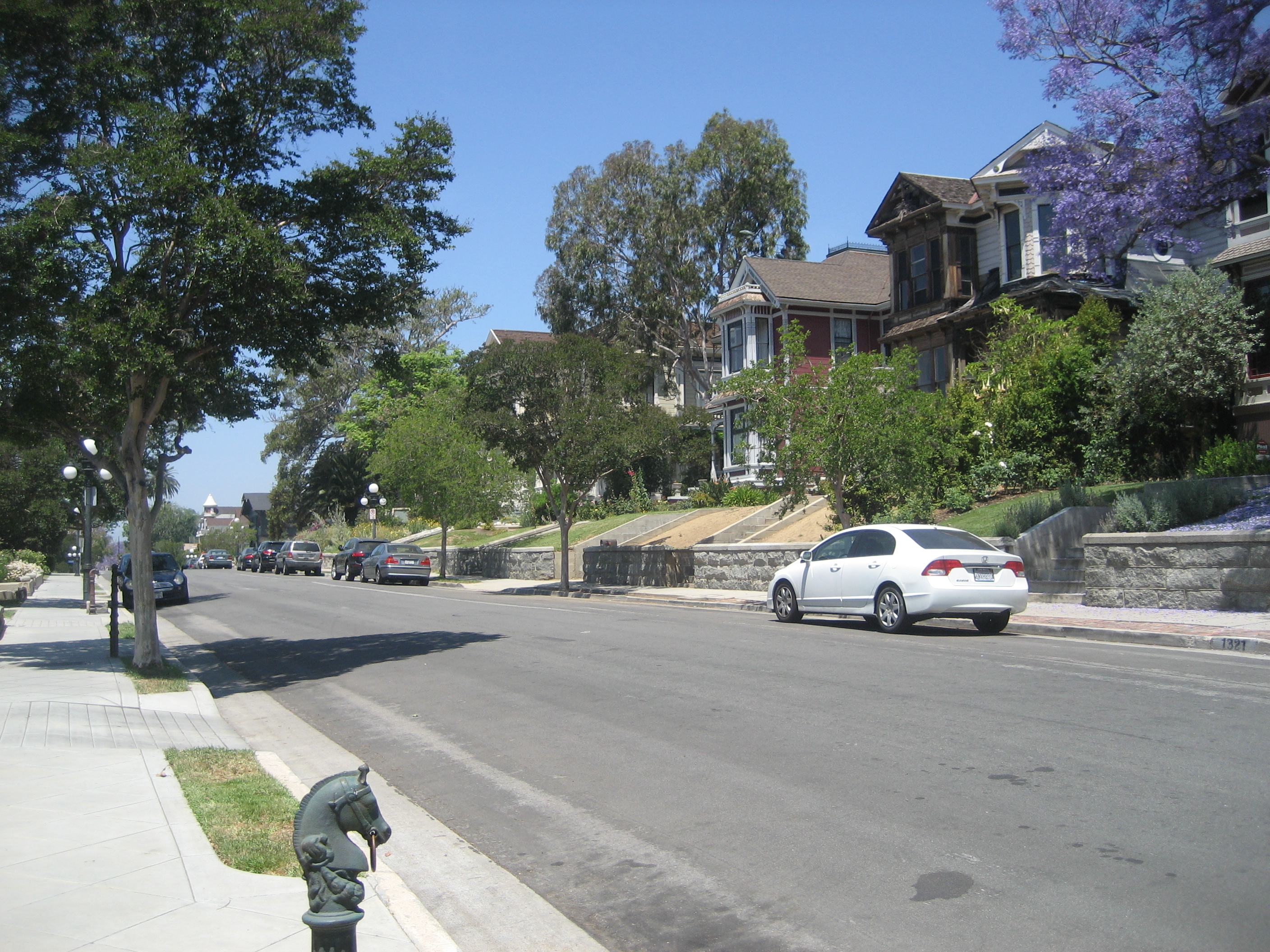
What makes Angelino Heights so fascinating to me is not only that the houses survived. It is that they survived in a city that has repeatedly made survival difficult.
This neighborhood was marketed as modern, convenient and aspirational in the 1880s and early 1900s. It had streetcar access, utilities, views, cleaner air and proximity to Downtown. In other words, it was sold using many of the same ideas Los Angeles real estate agents still use today: location, lifestyle and long-term value.
The difference is that Angelino Heights actually became historic.
A Suburb Before LA Really Had Suburbs
Today, Angelino Heights feels central. It sits near Echo Park, Silver Lake, Chinatown, Dodger Stadium and Downtown. But when it was developed, this was a residential escape from the older commercial core of Los Angeles.
The area was developed during the Southern California land boom of the 1880s. William W. Stilson and Everett E. Hall filed the subdivision in 1886 after purchasing the tract, and streetcar access along Temple Street helped residents reach Downtown in minutes.
That point matters.
Angelino Heights was not originally sold as a sleepy historic district. It was sold as progress. It offered space above the city, but still close enough to do business. It was a place where a growing middle and upper-middle class could buy into the future of Los Angeles without being stuck inside the older city center.
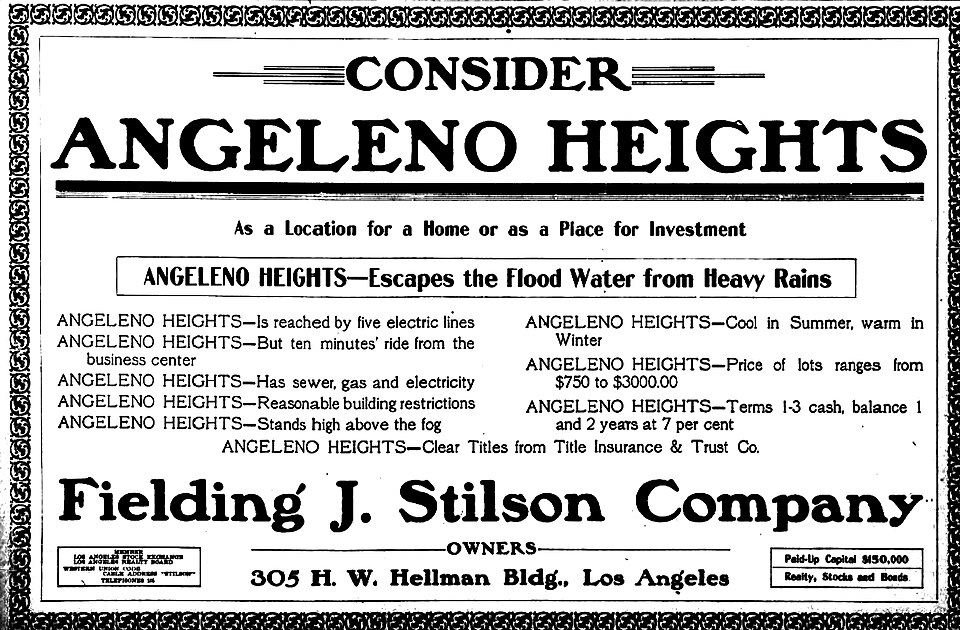
I love this old advertisement because it reads like a real estate pitch from another century, but the strategy is familiar. It emphasizes electric lines, sewer, gas, electricity, reasonable restrictions, clear titles and protection from flood water.
That is basically a 1906 version of saying: good infrastructure, good access, good upside.
Even the spelling in the ad, “Angeleno Heights,” is a reminder that neighborhoods evolve. Today, the official neighborhood name is generally Angelino Heights, but the early marketing language tells you how actively this place was being packaged and promoted.
Why the Houses Look So Different
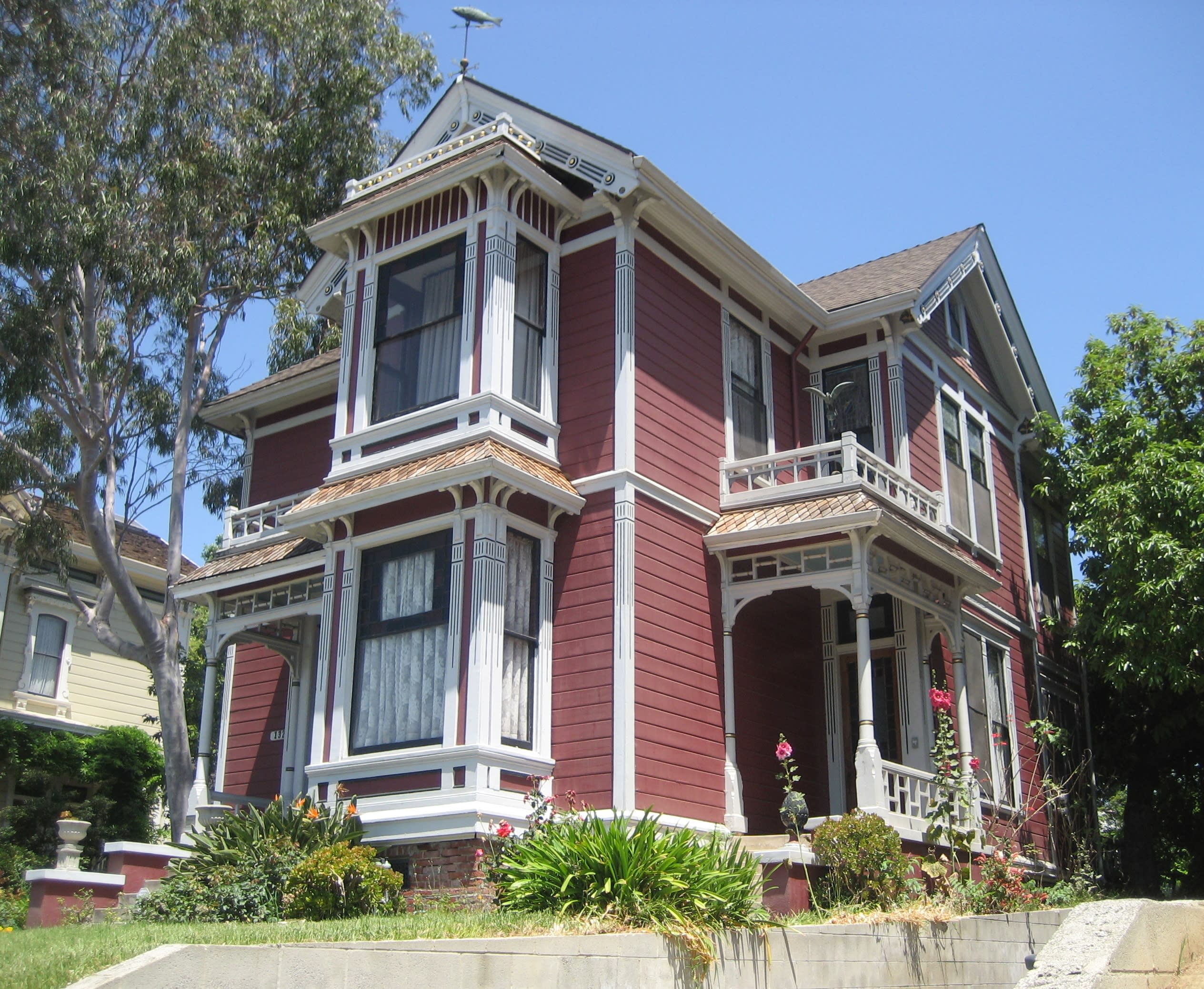
Angelino Heights is best known for its Victorian homes, especially the ones on Carroll Avenue.
City Planning says the 1300 block of Carroll Avenue is listed in the National Register of Historic Places and contains the highest concentration of 19th-century Victorian homes in Los Angeles. The larger HPOZ also includes later Craftsman and Mission Revival examples, which is part of why the neighborhood feels layered rather than frozen in one exact year.
The homes have steep roofs, decorative trim, towers, porches, bays, carved details and asymmetry. They were designed in an era when a house could be expressive. These were not flat boxes built to disappear. They had personality.
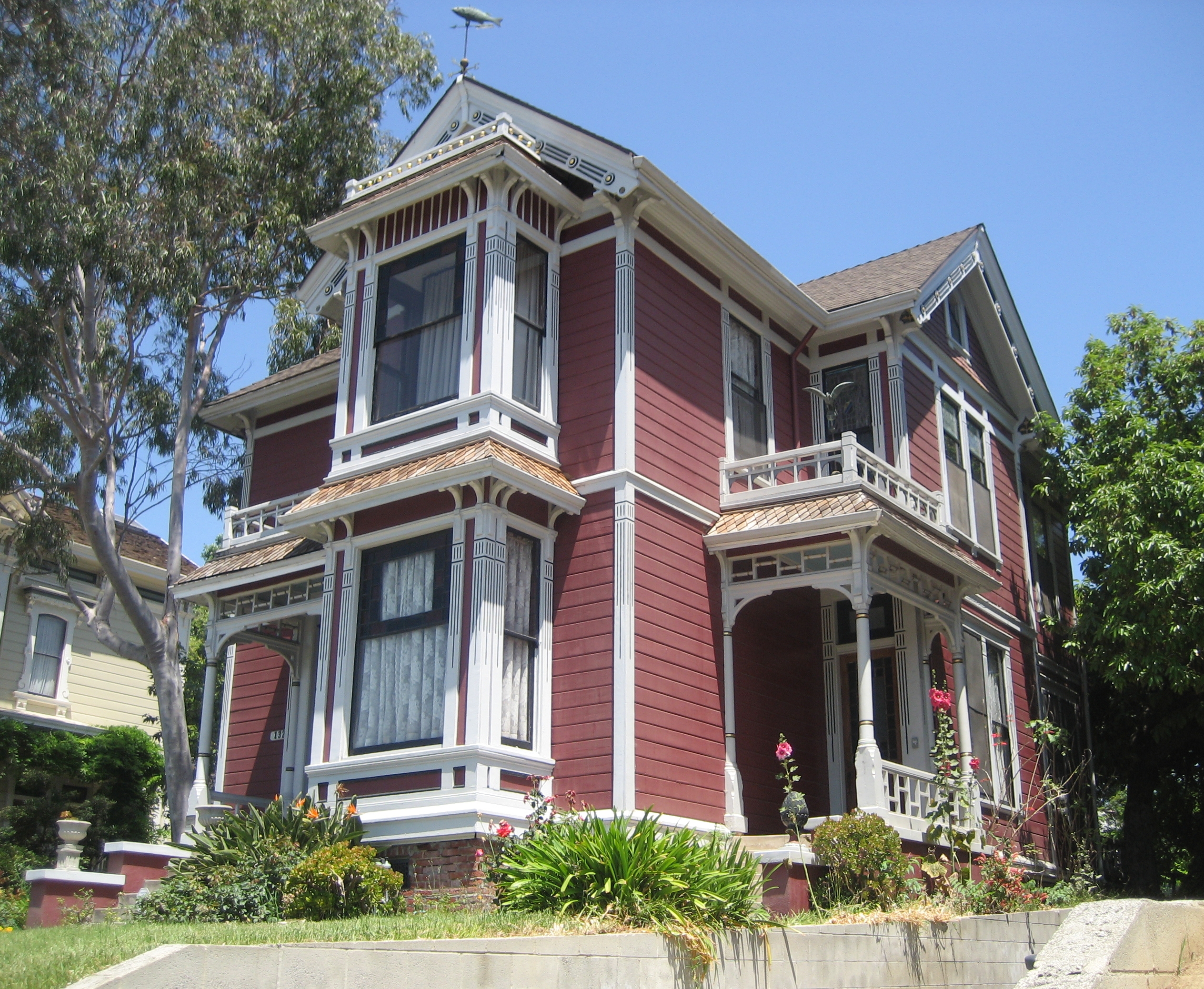
That is why Angelino Heights still feels cinematic. The houses have enough detail to hold your attention, but they also sit together as a streetscape. The power of the neighborhood is not one mansion. It is the concentration.
In most parts of Los Angeles, a single surviving Victorian home feels like an artifact. In Angelino Heights, the block still tells a story.
The Living Architecture Museum
In my reel, I described Angelino Heights as a kind of living architecture museum, and I think that is the right way to understand it.
This is not a museum where the homes are empty and roped off. People live here. They deal with maintenance, parking, tourists, filming, preservation rules and the normal headaches of owning old houses in a modern city.
But the neighborhood still teaches you something. It shows what Los Angeles looked like when residential status was moving out of the old Downtown core and into the hills just beyond it.
That is one reason the preservation designation matters. Angelino Heights became LA’s first HPOZ in 1983, after the city adopted the ordinance enabling HPOZs in 1979.
The point of an HPOZ is not to stop change completely. It is to manage change so the architectural and historic character of a neighborhood is not slowly destroyed one project at a time.
For Angelino Heights, that protection is the difference between a rare intact historic district and a few isolated old houses surrounded by incompatible construction.
Hollywood Found It Because It Felt Like Another City
Angelino Heights also became famous because it looks unlike most of Los Angeles.
Carroll Avenue is one of those places location scouts love because it can pass for another era. The house at 1329 Carroll Avenue became especially famous as the exterior used for Halliwell Manor in Charmed. IMDb lists 1329 Carroll Avenue as a filming location for the series, and Wikimedia identifies the house as the Eastlake Stick-style Victorian associated with the show.
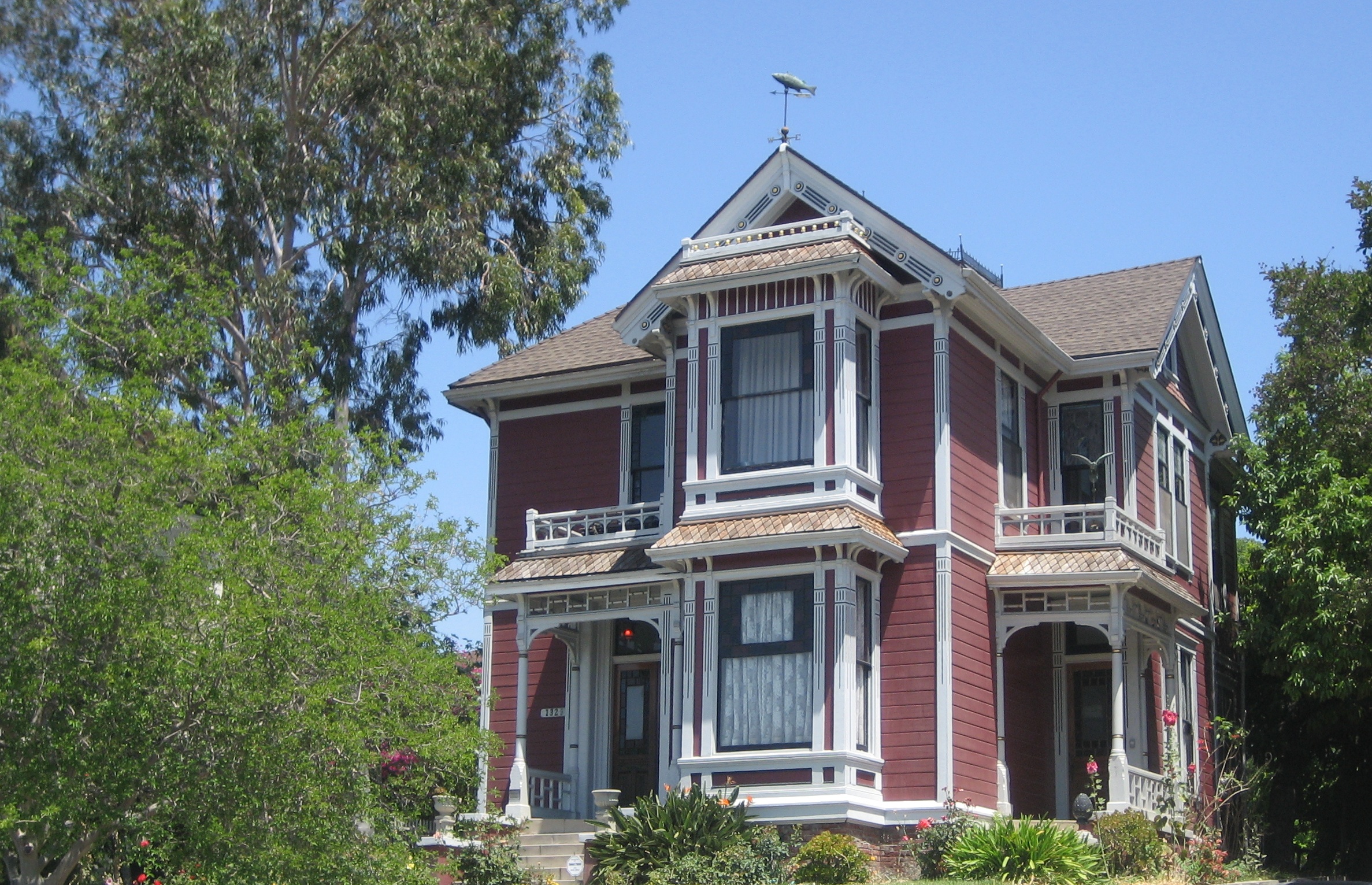
That is the funny thing about Los Angeles. Some neighborhoods become famous because they look like the future. Angelino Heights became famous because it still looks like the past.
Carroll Avenue has appeared in multiple productions, including Charmed, parts of Michael Jackson’s “Thriller” video and other movies and shows, according to reporting on recognizable film locations in Los Angeles.
But the filming popularity is also a double-edged sword. It brings attention, but it can also turn a residential street into a destination. People come to photograph homes that are still private property. That is part of the tension of living in a neighborhood that belongs both to residents and to the public imagination.
What Almost Destroyed It
The miracle of Angelino Heights is that it exists at all.
Los Angeles has not historically been gentle with its older neighborhoods. Bunker Hill lost many of its Victorian mansions. Freeways cut through established communities. Historic homes were demolished, moved, neglected or carved into apartments.
Angelino Heights was not spared. LAist notes that the 101 freeway bisected the neighborhood, and the LA Almanac states that a significant portion of the district was demolished and cleared in the late 1940s for construction of the Hollywood Freeway.
That is important because preservation stories can sometimes sound too romantic. We look at the beautiful houses that remain and forget the houses that were lost.
Angelino Heights survived, but not untouched.
The freeway changed its setting. Disinvestment changed its condition. Postwar neglect affected many Victorian homes across Los Angeles because they were expensive to maintain and no longer matched the architectural fashion of the moment.
That is why the preservation work here matters. Angelino Heights did not survive by accident. It survived because people eventually recognized that what remained was too valuable to lose.
Preservation Creates Value, But Also Responsibility
For buyers, Angelino Heights is attractive for obvious reasons. You get historic architecture, a central location, hillside character and proximity to Downtown, Echo Park and Silver Lake.
But buying in a neighborhood like this is very different from buying a standard house in a non-historic area.
If a property is inside the HPOZ, exterior changes visible from the street may require review. Windows, siding, porches, additions, fences, paint treatments and other visible work can involve design guidelines and approvals. The city’s overlay framework exists specifically to review projects in neighborhoods with architectural and cultural resources.
That does not mean you cannot improve a home. It means you need to understand the rules before you buy.
A historic house can be beautiful, but beauty is not the same thing as simplicity. You need to inspect systems carefully. Foundation, electrical, plumbing, roof, drainage, retaining walls and prior unpermitted work all matter. A charming Victorian can become very expensive very quickly if the buyer only falls in love with the facade.
My advice to buyers is simple: do not buy in Angelino Heights because it is cute. Buy there because you understand what you are taking on.
Why Sellers Should Not Treat These Like Ordinary Houses
For sellers, the opposite is also true. These homes should not be marketed like generic square footage.
The value is not only beds, baths and lot size. The value is architectural integrity, historic context, street presence, preservation status, location and story.
A properly presented Angelino Heights home should help buyers understand why the property is rare. It should explain the architecture, the neighborhood, the HPOZ, the proximity to Downtown and the significance of Carroll Avenue. It should also be honest about condition, restrictions and maintenance.
The wrong buyer may see historic designation as a burden. The right buyer may see it as the thing that protects the value.
That distinction matters in pricing and negotiation.
The Real Lesson of Angelino Heights
Angelino Heights teaches one of the most important lessons in Los Angeles real estate: scarcity is not always created by newness.
Sometimes scarcity is created by survival.
There are only so many places in Los Angeles where you can stand on a residential street and feel the 1880s still present. There are only so many blocks where the houses, the slope, the setbacks, the porches and the skyline still work together as a historic composition.
That is why Angelino Heights matters.
It is not just old. It is legible. You can still read the city’s early ambitions in the neighborhood. You can see how people once marketed elevated land above Downtown. You can see how streetcars shaped residential growth. You can see how architecture expressed status before the automobile took over Los Angeles.
And you can also see how fragile all of that is.
A freeway can cut through it. Disinvestment can wear it down. Speculation can distort it. Bad renovations can slowly erase it. But careful ownership, thoughtful preservation and community pride can keep it alive.
That is the real reason Angelino Heights is special.
It survived long enough for Los Angeles to realize what it had.
If you are thinking about buying or selling in Angelino Heights, Echo Park, Silver Lake or anywhere else in Los Angeles, contact me, Tyler Neale. I can help you evaluate not just the property, but the history, neighborhood dynamics and market positioning that determine what an exceptional Los Angeles home is really worth.